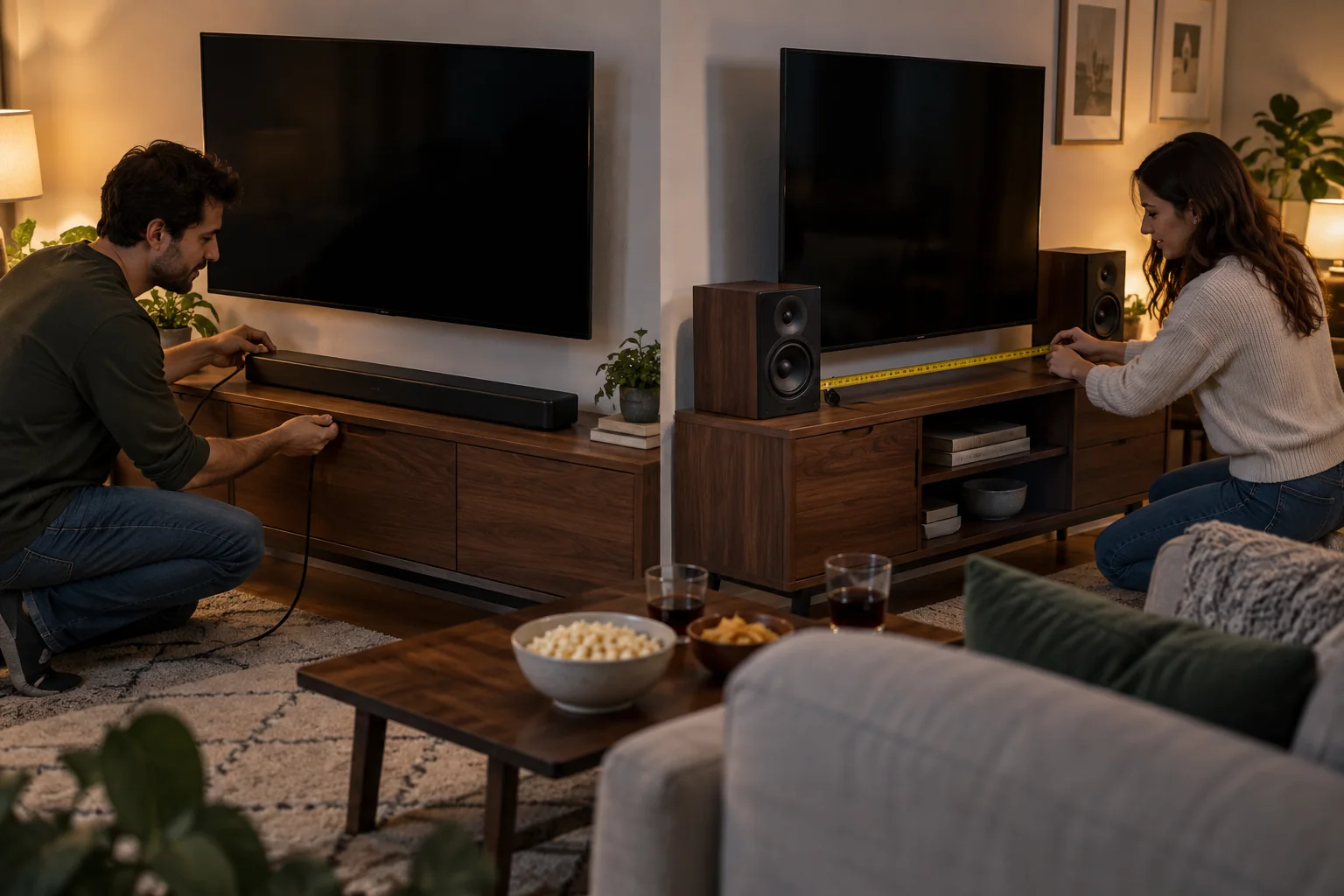
Choose audio around the room, seating and daily sources. Soundbars package channels and television control into one low object. Separate speakers offer placement flexibility and stereo width, but need stands, cables or more furniture.
Before comparing formats, confirm the television’s audio outputs, cabinet width, wall clearance and whether the household will tolerate visible speakers. Better sound that creates constant friction is not better for the room.
Best for
Living rooms upgrading thin television sound without building a dedicated theater.
Skip it if
Furniture, neighbors or room acoustics have not been considered.
Measure the television zone
Record cabinet width, screen-bottom clearance and wall depth. A soundbar should not cover the picture or infrared receiver. Separate speakers need symmetrical positions near ear height and enough distance from corners for balanced sound.
Map power and signal cables. Wireless surrounds still need power. If the room cannot support safe routes, a simpler front system may outperform an ambitious plan assembled with extension cords.
Decide whether television or music leads
Dialogue enhancement, HDMI control and one remote favor a soundbar. Music listeners may prefer two speakers that produce a clear left-right stage. Some wireless ecosystems can begin with room speakers and later join a television system, but verify model-specific compatibility.
A subwoofer adds impact and can improve small speakers, yet low bass travels through structures. Apartment listeners should value placement and neighbor comfort over maximum output. Room correction helps, but cannot remove every acoustic problem.
Buy the smallest complete system
A high-quality bar or pair of speakers used every day is a better start than a cheap surround package with awkward placement. Listen at normal volume and prioritize intelligible speech and even sound across the seating area.
Check return policy, supported formats and software-update expectations. If a system depends on an app for setup, make sure basic volume and source control remain straightforward for everyone.
Before you spend
- Measure cabinet and screen clearance
- Map power for every component
- Choose television-first or music-first
- Consider neighbors and bass travel
- Test normal-volume dialogue